
Open-cell and closed-cell foam
Spray Foam Insulation in Pensacola, FL
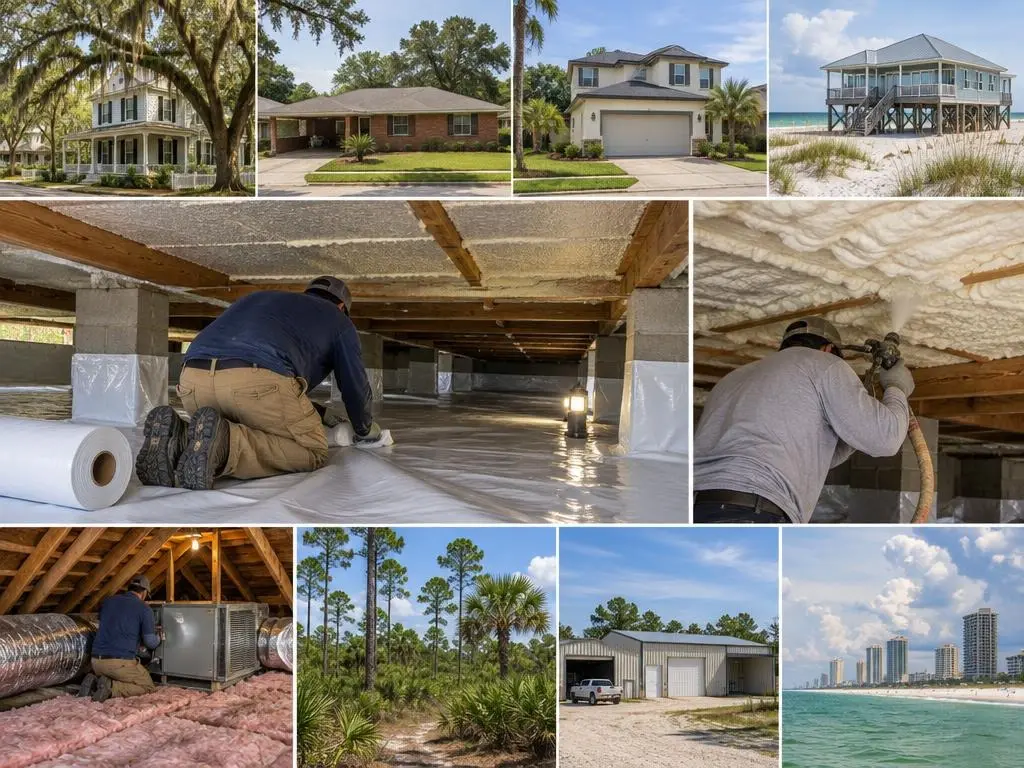
Foam chosen surface by surface: open-cell where sealing and sound matter most, closed-cell where moisture is in play.
- Free on-site estimates
- Written quote with foam type, thickness and R-value per area
- Moisture, leaks and termite clearances checked before we spray
One Layer That Insulates and Seals
Spray foam insulation does two jobs at once, and in Pensacola the second job matters as much as the first. Foam goes on as a liquid, swells into every crack and cures in place, so it slows heat and stops air in a single layer. Stopping air is the big win in a city where Wikipedia's climate normals show July nights averaging 75.3F and about 68 inches of rain a year. Outdoor air here is hot and wet much of the year, and every leak lets in both. We spray two kinds of foam, and picking between them is the first decision on every job.
Closed cell vs open cell
Open-cell foam cures soft and spongy. HomeGuide lists it at R-3.5 to R-3.7 per inch. It expands a great deal, fills odd-shaped cavities, seals air well and dampens sound, and it costs less per square foot. Water vapor can pass slowly through it, and it can soak up liquid water if a leak reaches it, which is one reason a roof leak under open-cell needs to be fixed fast.
Closed-cell foam cures hard and dense at R-5 to R-7 per inch. At typical thickness it slows vapor and does not soak up water, and it stiffens the surface it bonds to. It costs more per inch but packs more R-value into less space.
Around Pensacola, closed-cell is the usual choice under raised floors, on crawl space walls, on metal buildings and anywhere the foam may see moisture. Open-cell is common on the underside of roof decks in sealed attics, in interior walls and in walls opened up during remodels.
Sealed attics and the ductwork question
In a great many homes around the bay, the air handler and ductwork sit in the attic. On a July afternoon, a vented attic can get far hotter than the outdoor air, and leaky ducts in that space pull in hot, humid air. Spraying foam on the underside of the roof deck and the gable walls turns the attic into a semi-conditioned space, so the ducts work in milder air. Codes allow this when specific conditions are met, and the HVAC system should be checked afterward because the house will behave differently. It is not right for every house; a simple attic with ducts in good shape may be better served by sealing the ceiling and adding blown-in to depth.
What the code says about thickness
OpenEI's IECC climate zone list places Escambia and Santa Rosa counties in Zone 2A. The Insulation Institute's summary of the 2023 Florida Building Code, Energy Conservation lists R-38 for ceilings and R-13 for wood-frame walls in Zone 2 on the prescriptive path. Sealed attic assemblies and other options can follow other paths in the code, so the right foam thickness depends on how the house is being permitted and what the goal is. We size the thickness to a target and put both numbers on the quote.
Walls opened by remodels and storm repairs
Standard foam needs an open cavity. When walls are stripped to the studs, whether for an addition, a kitchen remodel or repairs after a hurricane, it is the easiest time to foam them. Open-cell fills a 2x4 cavity and seals the outlets, plates and window gaps that let humid air in. Closed-cell is the choice where walls may get wet again or where a few inches need to carry a higher R-value. For closed walls that will stay closed, dense-pack blown insulation or an injection foam made for existing cavities are the usual routes, and we explain the trade-offs.
What foam is not for
Foam does not fix a leak. A roof, window or plumbing leak has to be repaired first, or foam will hide water that rots wood out of sight. It should not cover old wiring that needs checking, and it does not belong on the outside of foundation walls below grade in Florida. The Florida Building Commission's termite guidance keeps foam plastic off below-grade foundation walls and calls for a 6-inch gap between exterior foam and the ground so termite activity stays visible.
Getting ready and getting back in
Spraying goes quickly; the prep takes longer. We cover floors and belongings, mask what needs masking and set up ventilation. HomeGuide advises staying out for 24 hours or more while the foam cures, so most families plan a night away for interior work. Once cured, foam does not settle or sag, so the thickness we leave is the thickness you keep.
Tell us what you have noticed: a hot upstairs, sweating ducts, a musty smell, high summer bills. We will look, explain where foam earns its cost and send a written price. Get a free estimate
Where Spray Foam Goes
The places we spray most often around Pensacola, and the foam we usually choose.
Open-cell spray foam
Light foam at R-3.5 to R-3.7 per inch (HomeGuide) that seals air and dampens sound; common on roof decks in sealed attics and in interior walls.
Closed-cell spray foam
Dense foam at R-5 to R-7 per inch that slows vapor and resists water; used under raised floors, on crawl space walls and on steel.
Sealed attic rooflines
Foam on the underside of the roof deck and gable walls so ducts and the air handler sit in milder air.
Floors over crawl spaces
Closed-cell under raised wood floors where humid crawl space air reaches the framing.
Walls during remodels and storm repairs
Open stud bays filled while the drywall is off, sealing outlets, plates and window gaps.
Bonus rooms and kneewalls
Sealing the walls, floors and sloped ceilings around rooms built into the attic or over the garage.
Metal buildings and shops
Closed-cell on steel walls and roofs to insulate and stop condensation.
Published Spray Foam Insulation Costs
| Job | Range and source |
|---|---|
| Spray foam, installed | $1.50 to $5.00 per sq ft (HomeGuide) |
| Open-cell / closed-cell | $1.50 to $3.50 / $3.00 to $5.00 per sq ft (HomeGuide) |
| About 1,000 sq ft | $1,500 to $5,000 (HomeGuide); $3,150 to $7,500 existing home (Fixr) |
| Existing walls / new construction | $3.15 to $7.50 / $2.75 to $6.50 per sq ft (Fixr) |
| All exterior walls | $4,000 to $10,000 (HomeGuide) |
| Whole house | $8,000 to $20,000 (HomeGuide); $10,000 to $30,000 (Fixr) |
| Typical job minimum | $1,000 to $2,000+ (HomeGuide) |
National ranges from HomeGuide's 2026 guide and Fixr's 2025 guide, shown for planning. Foam type, thickness, access and prep move the total, and small jobs often land at a minimum. What you pay is the number on the written estimate we hand you.
How a Spray Foam Job Runs
1. Look at the house
We check the attic, ducts, crawl space or walls for leaks, damp wood, pests and wiring, and measure.
2. Written quote
Each area lists open- or closed-cell, thickness, target R-value and price.
3. Prep
Cover and mask, set up ventilation, and plan around the AC if the attic is being sealed.
4. Spray
Foam goes on in passes to the planned thickness, and we trim where needed.
5. Clean up and walk through
We clean up, show you the work and tell you when the space is ready.
Why Choose Us for Spray Foam Insulation
Foam only where it pays
If blown-in or simple air sealing does the job for less, we say so.
Thickness in writing
Thickness and R-value are on the quote so bids compare fairly.
Termite clearances respected
Foam stays off the ground and out of the areas inspectors need to see.
Spray Foam Insulation Questions
Is open-cell or closed-cell better for a Pensacola attic?
For a sealed attic roofline, open-cell is common because it seals air well and costs less per square foot. Closed-cell makes sense where moisture may reach the foam or where space is tight. We name the foam for each area on the quote.
Can spray foam go into existing closed walls?
Standard foam cannot, because it expands too fast and needs an open cavity. Closed walls are usually filled with dense-pack blown insulation or an injection foam made for that use.
How long do we need to stay out after spraying?
HomeGuide advises allowing 24 hours or more. For a detached garage or shop, it may not affect the house at all. We confirm timing for your job.
Will spray foam cause moisture problems in a humid climate?
Installed correctly, foam reduces moisture problems by stopping humid air from leaking in. The risks come from covering leaks or wet wood, so we check for those first, and from sealing an attic without checking how the AC handles humidity afterward.
Does spray foam help in a hurricane?
Foam is insulation, not storm protection, and we do not sell it as a hurricane fix. Its job is to insulate and seal. Roof, window and opening protection are separate questions for a roofer or builder.

Spray Foam Insulation Service Areas
- Spray Foam Insulation in Pensacola, FL
- Spray Foam Insulation in Gulf Breeze, FL
- Spray Foam Insulation in Pensacola Beach, FL
- Spray Foam Insulation in Perdido Key, FL
- Spray Foam Insulation in Orange Beach, AL
- Spray Foam Insulation in Warrington, FL
- Spray Foam Insulation in Myrtle Grove, FL
- Spray Foam Insulation in West Pensacola, FL
- Spray Foam Insulation in Brent, FL
- Spray Foam Insulation in Bellview, FL
- Spray Foam Insulation in Ensley, FL
- Spray Foam Insulation in Ferry Pass, FL
- Spray Foam Insulation in Cantonment, FL
- Spray Foam Insulation in Gonzalez, FL
- Spray Foam Insulation in Molino, FL
- Spray Foam Insulation in Pace, FL
- Spray Foam Insulation in Milton, FL
- Spray Foam Insulation in Midway, FL
- Spray Foam Insulation in Navarre, FL
Get a Spray Foam Insulation Estimate
Tell us what feels wrong in the house. We will look and send a written foam plan and price.