
Raised floors, damp crawl spaces
Crawl Space Encapsulation & Insulation in Pensacola, FL
Keep Gulf Coast humidity away from your floor framing, with a sealed liner and foam or a properly insulated floor.
- Free on-site estimates
- Written quote with foam type, thickness and R-value per area
- Moisture, leaks and termite clearances checked before we spray
Humid Air Under the Floor
Crawl space encapsulation and insulation in Pensacola deal with a problem most of the country does not have to think about in summer: hot, wet outdoor air flowing under a cool house. Older houses near downtown and many beach homes sit on piers or short foundation walls with a vented crawl space below. In the warm months, outside air with a lot of water in it moves through those vents and meets wood floors cooled by the air conditioning above. Where it touches the cooler surfaces, it can condense. Over time that means damp subfloors, sagging or moldy batts, musty smells inside and an easy life for termites and other pests.
Two ways to handle a crawl space
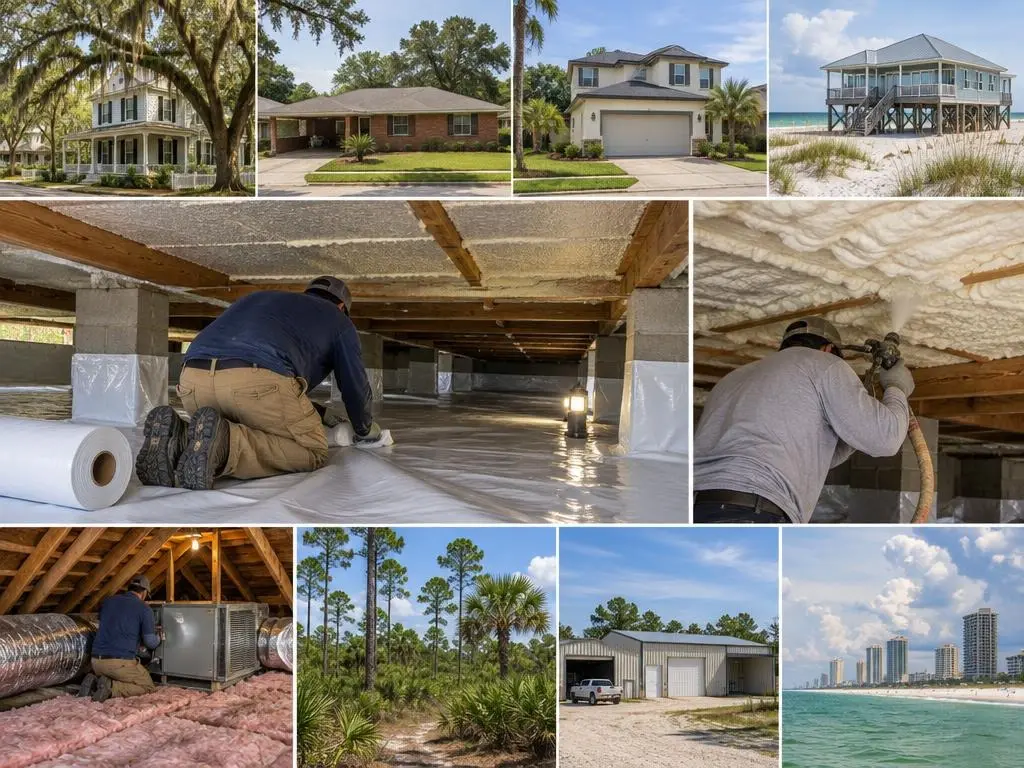
The first is to keep the crawl space vented and insulate the floor above it. DOE lists R-13 for an uninsulated floor in Zone 2. In our climate, fiberglass batts between floor joists often fail here: they hold moisture, sag and fall. Closed-cell spray foam sprayed directly to the underside of the subfloor works better, because it seals the floor, slows vapor and does not soak up water.
The second is encapsulation. We close the foundation vents, cover the ground with a heavy liner sealed at the seams and up the walls, and insulate the crawl space walls with closed-cell foam where it is appropriate. The crawl space becomes part of the house's air, usually with a dehumidifier or a small supply of conditioned air to keep it dry. It costs more but tends to work better under a house with ductwork or plumbing below the floor.
Termite rules shape the details
Florida is termite country, and that affects how foam goes into a crawl space. The Florida Building Commission's termite-protection guidance keeps foam plastic off below-grade foundation walls and calls for a 6-inch clearance between exterior foam plastic and the ground. Inside a crawl space, we leave an inspection strip where pest control companies need to see the top of the foundation and the sill, and we talk with you about your termite contract before we cover anything. If we see mud tubes or damaged wood, we stop and tell you.
What we check before we quote
We look for standing water and the reason for it, such as grading, gutters, plumbing leaks or a low lot. Encapsulation is not a fix for flooding; water has to be dealt with first. We check the moisture in the floor framing, look at any ductwork running through the crawl space, note how much headroom there is to work, and look at the foundation vents and access door. Low clearance and debris add time, so they go on the quote.
Raised beach houses are different
Homes on tall pilings at Pensacola Beach, Navarre Beach and Perdido Key do not have a crawl space in the usual sense; the floor is open to the wind. There, closed-cell foam on the underside of the floor deck, protected by the soffit or covering the design calls for, insulates and seals the floor without fighting the open air below. Flood-zone rules can limit what goes below the lowest floor, so we check those details with the owner and builder.
Slab homes
Many ranch homes around Pensacola sit on slabs with no crawl space at all. For those, this service does not apply, and the attic and walls are where we focus.
If you have a soft floor, a musty smell or sagging insulation under the house, tell us. We will look and send a written plan. Get a free estimate
Crawl Space Work We Do
Options for raised floors around Pensacola, from simple floor insulation to full encapsulation.
Closed-cell under the subfloor
Foam sprayed to the underside of the floor in a vented crawl space, replacing failing batts.
Vapor barrier liner
A heavy ground cover sealed at the seams and up the walls to block ground moisture.
Vent and access sealing
Closing foundation vents and sealing the access door as part of encapsulation.
Crawl space wall insulation
Closed-cell foam on interior crawl space walls, with termite inspection strips left open.
Old batt removal
Pulling sagging, wet or moldy batts out from under the floor and bagging them for disposal.
Floors on pilings
Foam under elevated floor decks on raised beach houses, covered as the design requires.
Published Crawl Space Costs
| Job | Range and source |
|---|---|
| Crawl space encapsulation | $3 to $10 per sq ft, $3,000 to $15,000 (HomeGuide) |
| Crawl space vapor barrier | $1,200 to $4,000 (HomeGuide) |
| Crawl space vent sealing | $150 to $450 (HomeGuide) |
| Closed-cell on crawl space walls | $2 to $5 per sq ft (HomeGuide) |
| Crawl space, spray foam | $2,000 to $4,000 (HomeGuide); $1,000 to $5,900 (Fixr) |
| Closed-cell, installed | $3.00 to $5.00 per sq ft (HomeGuide) |
These figures come from HomeGuide's January 2026 crawl space encapsulation guide, its 2026 spray foam guide and Fixr's 2025 guide, and they are national. Square footage, headroom, debris, water problems and the liner chosen decide your total. The written estimate after our visit is the price.
From First Look to Dry Crawl Space
1. Inspect
Check water, framing moisture, termite signs, ducts, headroom and vents.
2. Choose a plan
Insulated floor or full encapsulation, explained and priced side by side.
3. Clear and prep
Remove old batts and debris and fix anything that must come first.
4. Install
Spray the floor or walls, lay and seal the liner, and close vents if encapsulating.
5. Review
Show you the finished space and the inspection strips left open.
Why Choose Us for Crawl Space Encapsulation & Insulation
Water first
We point out drainage and leak problems before anything is sealed.
Termite access kept
Inspection strips stay open so your pest control company can do its job.
Both options priced
Floor insulation and encapsulation shown side by side when both fit.
Crawl Space Encapsulation & Insulation Questions
Should I encapsulate my crawl space in Pensacola?
If the crawl space has ductwork or plumbing, smells musty or the floor framing stays damp, encapsulation usually works better. If it is dry and simple, foam under the subfloor may be enough. We price both.
Why is the insulation falling down under my house?
Fiberglass batts under a raised floor absorb moisture in humid weather, get heavy and drop out of the joists. Closed-cell foam bonded to the subfloor does not have that problem.
Will foam in the crawl space hide termites?
It can if done carelessly. We leave inspection strips open at the sill and top of the foundation, keep foam off below-grade foundation walls and talk to you about your termite contract first.
Does an encapsulated crawl space need a dehumidifier?
Usually it needs some way to stay dry, either a dehumidifier or a small amount of conditioned air from the HVAC system. We explain what fits your house.
My crawl space floods after heavy rain. Can you encapsulate it?
Not until the water is handled. Grading, gutters or drainage come first. Sealing a crawl space that floods only traps the water.

Crawl Space Encapsulation & Insulation Service Areas
- Spray Foam Insulation in Pensacola, FL
- Spray Foam Insulation in Gulf Breeze, FL
- Spray Foam Insulation in Pensacola Beach, FL
- Spray Foam Insulation in Perdido Key, FL
- Spray Foam Insulation in Orange Beach, AL
- Spray Foam Insulation in Warrington, FL
- Spray Foam Insulation in Myrtle Grove, FL
- Spray Foam Insulation in West Pensacola, FL
- Spray Foam Insulation in Brent, FL
- Spray Foam Insulation in Bellview, FL
- Spray Foam Insulation in Ensley, FL
- Spray Foam Insulation in Ferry Pass, FL
- Spray Foam Insulation in Cantonment, FL
- Spray Foam Insulation in Gonzalez, FL
- Spray Foam Insulation in Molino, FL
- Spray Foam Insulation in Pace, FL
- Spray Foam Insulation in Milton, FL
- Spray Foam Insulation in Midway, FL
- Spray Foam Insulation in Navarre, FL
Get a Crawl Space Encapsulation & Insulation Estimate
Soft floor or musty smell? Tell us and we will look under the house and price the options.